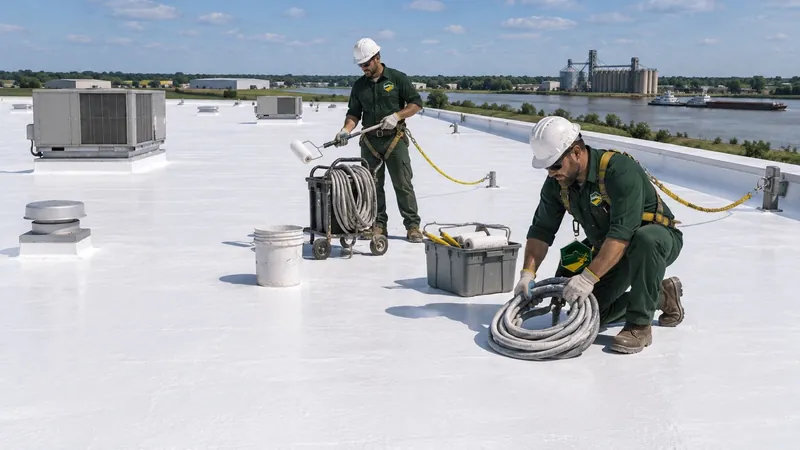
Full coating systems for low-slope and metal roofs on warehouses, plants, and retail buildings, applied over the existing roof.
Ready To Coat When
the deck is solid, the insulation tests mostly dry, and the surface can be cleaned to bond.

Commercial Roof Coating in Daviess County
As an Owensboro roof coating contractor, we clean, repair, and coat metal, single-ply, modified bitumen, and foam roofs on commercial, industrial, and agricultural buildings.
Coating Systems
An Owensboro roof coating contractor puts a new waterproof surface over the roof you already have. Each system below has a condition the roof must meet first.
Full coating systems for low-slope and metal roofs on warehouses, plants, and retail buildings, applied over the existing roof.
Ready To Coat When
the deck is solid, the insulation tests mostly dry, and the surface can be cleaned to bond.
Moisture-tolerant silicone for flat roofs that hold some water after rain, sprayed or rolled over primed seams and flashing.
Ready To Coat When
drains work, the low spots are mapped, and the membrane is still attached.
Water-based acrylic for roofs that shed water well, such as sloped metal, applied in warm, dry weather.
Ready To Coat When
the roof drains freely and the forecast shows dry days for curing.
Rust treatment, fastener sealing, and lap reinforcement before a white coating goes over the panels.
Ready To Coat When
panels still carry weight and rust has stayed on the surface of the metal.
Low-slope roofs on strip centers and offices, coated after drains, scuppers, and parapet flashing are repaired.
Ready To Coat When
core samples come back mostly dry and water clears the roof within two days.
Polyurethane foam sprayed over the existing roof to insulate and build slope, then protected with a top coat.
Ready To Coat When
the old surface is dry, firmly attached, and clear of loose gravel.
Aged TPO membranes cleaned, primed for single-ply, and coated once open seams are rewelded or taped.
Ready To Coat When
the membrane is still fastened down and every open seam can be closed.
Black rubber roofs scrubbed of chalking, primed with an EPDM primer, and coated white to cut heat gain.
Ready To Coat When
laps still hold and the rubber lies flat against walls and curbs.
Granulated modified bitumen and smooth built-up roofs repaired at blisters and cracks, then primed against asphalt bleed.
Ready To Coat When
blisters are few and any loose gravel can be cleared off.
Inspection, cleaning, wet-area replacement, seam and flashing work, and a full coating system in one planned project.
Ready To Coat When
the roof is worn on top but solid underneath.
Suitability
A roof is ready to coat when the deck is solid, most of the insulation is dry, and the surface will bond. Find the condition closest to yours.
| Roof Condition | Coat It | Repair, Then Coat | Replace First |
|---|---|---|---|
| Weathered, chalky surface with no leaksClean, prime where needed, and coat. | Usual path | Possible after testing | Not the usual path |
| Leaks at seams, laps, or flashingSeams and flashing get reinforced first. | Possible after testing | Usual path | Not the usual path |
| Water ponding in a few low spotsDrains checked, then silicone over the low areas. | Possible after testing | Usual path | Not the usual path |
| Small wet areas found by moisture readingsWet sections cut out and replaced, then coated. | Not the usual path | Usual path | Possible after testing |
| Widespread wet insulation or a soft deckReplacement is usually the better path. | Not the usual path | Possible after testing | Usual path |
| Metal panels rusted through or saggingCoating cannot rebuild missing metal. | Not the usual path | Possible after testing | Usual path |
Process
Every coating project runs in four stages, and the inspection decides whether the other three go ahead.
Every section of the roof gets walked. We take moisture readings or core samples where the surface feels soft, test adhesion on a small patch, and watch how water leaves the roof. You hear what we found before any coating plan is written.
Wet insulation is cut out and replaced with dry board and matching membrane. Open seams, split flashing, loose fasteners, and blisters are repaired so the coating goes over a closed, dry roof instead of hiding a problem.
Power washing removes dirt, chalking, and loose granules. Once the roof dries, primer goes on where the surface calls for it, such as single-ply, EPDM, rusted metal, or asphalt roofs that would bleed through.
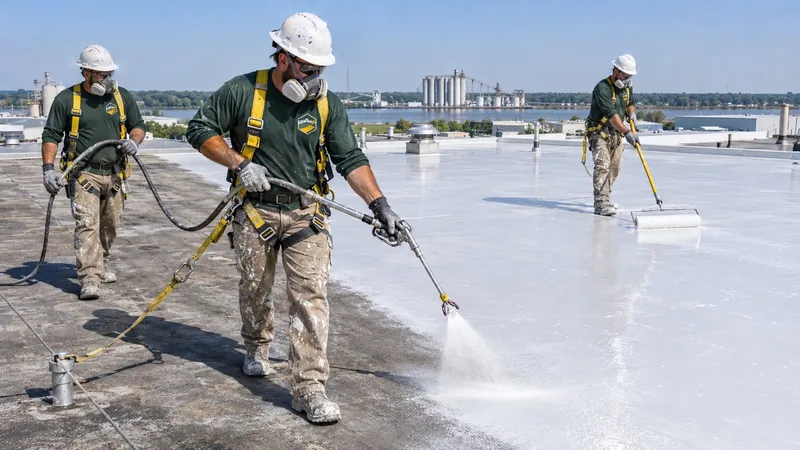
The coating is sprayed or rolled at the specified thickness, with extra passes at seams and penetrations. We check wet and dry thickness as we go and walk the finished roof with you before the job is closed out.
Call and tell us the roof type, the building size, and where the water sits. We will tell you whether silicone is worth a look.
Roof Conditions
These conditions show up on Owensboro commercial roofs every season. Here is what a coating project does about each one.
Ceiling stains that line up with membrane seams or metal laps usually mean a seam has opened or its sealant has dried out.
What We Do
Reinforce the seam with fabric and coating, or tape it, before the full coat.
Orange streaks at fasteners, end laps, and eaves show where the factory finish has worn through on an older metal roof.
What We Do
Wire-brush, treat with rust-inhibiting primer, and seal fasteners before coating.
Water that sits in the same low spots after each storm wears the surface faster and finds any open seam nearby.
What We Do
Clear and check drains first, then use silicone where some ponding remains.
Modified bitumen and built-up roofs crack and blister as the asphalt ages and dries out in the sun.
What We Do
Cut and repair blisters, fill cracks, prime against bleed-through, then coat.
Dark or weathered roofs absorb summer sun, which heats the roof surface and the space under it.
What We Do
A white coating reflects much of that sunlight back off the roof.
Why Coat
Coating keeps the existing roof in place, so most of the benefit comes from the work you skip. Each one depends on a roof solid enough to coat.
Our ballpark range for coating is $2.50 to $4 per square foot, against $5 to $8 for replacement, because tear-off, disposal, and new insulation mostly drop out.
Work happens on the roof surface, so shelving, production lines, and offices below keep running while each section is coated.
Keeping the old membrane or panels in place means far fewer dumpster loads leaving your property for the landfill.
When the coating wears, the roof can be cleaned and recoated instead of torn off, as long as the layers below stay dry.
Going Local
Owensboro has river industry, retail corridors, and plenty of metal farm buildings, and each brings its own kind of roof to the job.
The Riverport on the Ohio River lists eight on-site warehouses totaling about 500,000 square feet. Large metal and single-ply roofs like these are coated in sections around loading and rail activity.
Owensboro-Daviess County Regional Airport sits about three miles southwest of the city, with plants and warehouses around it. Their big low-slope roofs suit silicone or acrylic systems scheduled around shifts.
Flat roofs behind parapets are common on retail buildings and offices along Frederica Street and across the east side. Coating work stays up top, so stores keep their lots and doors open.
Machine sheds, grain buildings, and farm shops in Daviess County often carry metal roofs with rusted laps and loose fasteners. Those get sealed and primed before a white coating goes on.
Service Area
Besides Owensboro itself, these are the towns where we regularly coat roofs. If your building sits outside the list, call and ask.

We Also Coat Roofs In
FAQ
Short answers to what owners ask before a coating project. The full list is on our roof coating FAQ.
Our free ballpark estimate puts coating at $2.50 to $4 per square foot, so a 20,000-square-foot roof lands between $50,000 and $80,000 before inspection findings. Wet-area replacement, seam repair, the coating type, film thickness, and roof access move the final number.
Yes, in most cases. The work happens on the roof surface, so the building below stays open. Spray days are planned around wind, parked vehicles, and rooftop air intakes, which get shut down or covered while spraying happens near them.
Coating life depends on the product, the thickness applied, the surface prep, and how much water and foot traffic the roof sees. Thicker coats over well-prepared roofs last longer, and most systems can be cleaned and recoated instead of torn off.
Coating makes sense when the roof is worn on top but solid underneath. A roof with widespread wet insulation, a rusted-through deck, or structural damage needs repair or replacement before any coating goes on.
Next Step
Send the roof size and type for a free ballpark range, or call and describe the roof. Every coating plan starts with an inspection.